
Did you know that babies are actually cannibals?!
When you think about it, is there anything more magical than growing a baby? You literally start with one squishy cell in the middle of Mummy‘s tummy, and over the next nine months, in less time than it takes for the average house to be built, you end up with a living breathing human being with eyeballs, fingernails, and a brain that’s already capable of sensing so much of the world around it, all built around a scaffold of solid (or soon be solid) bones. All of that without mum having to consciously do anything except keep herself relatively healthy!
The genetic instructions for 3D printing a human being are so comprehensive that, as long as the raw ingredients are provided, the womb can do the rest all by itself. Those ingredients include proteins for growth, sugars for energy, and are ready supply of vitamins and minerals for building specialised cells and body machinery.
And it continues much the same after baby has been born. On a diet of only milk, albeit milk that is specially formulated to contain all of those raw ingredients, a newborn will double in size in just six months. If you’re breastfeeding your little one, that specially formulated milk comes direct from you, and your body automatically adjusts the formula to make sure the balance of nutrients is exactly what baby needs. It’s a miracle of biology, but it comes at a cost to all you moms out there. Because for baby to get what they need, especially when it comes to calcium, moms pay the price with their own bodies.
How much calcium do babies need?
Calcium is essential in the body. It helps to make all of your cells work, from your brain to your intestines. But in a developing baby, its most important role is to help grow bones.
Babies are actually born with more bones than adults, all of which have to be grown from scratch, so it’s hardly surprising that their calcium requirements are pretty high!
During the third trimester of pregnancy, when a fetus is really doubling down on growing their bony scaffold, they will absorb 300 milligrams of calcium a day, amounting to about 30g in total by the time they’re born.
But they’re going to need much more than that If they’re going to grow into big, strong adults! A grownup has between 1.2 and 1.4 kilograms of calcium in their bodies, and since baby is going to be tripling in weight in their first year, their bones need to keep pace with all that extra mass.
So in their first year, they’ll take in at least 400 milligrams of calcium every single day. That amounts to about the weight of a penny in pure calcium, every week. This increases to about 700 milligrams between ages 1 and 3, and one full gram per day between ages 4 and 8.
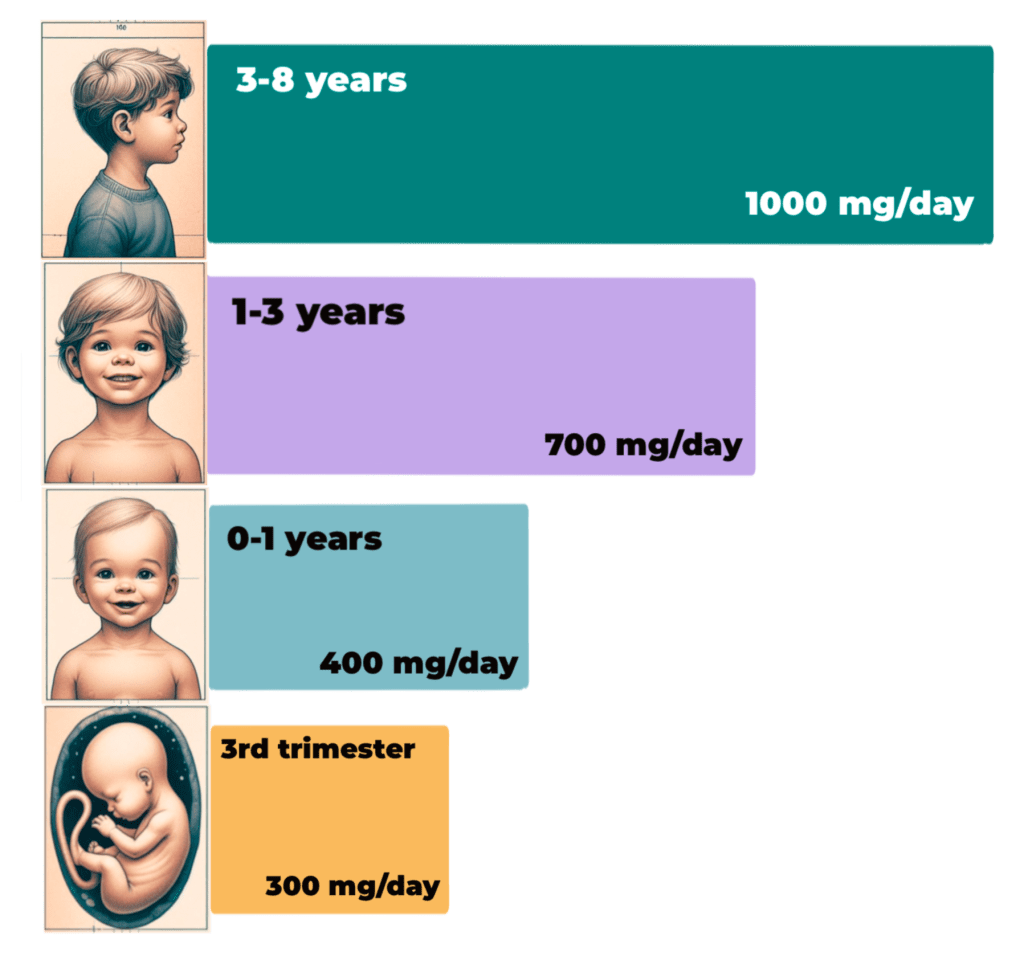
If a young child has a calcium deficiency, they run the risk of fractures, rickets, and may not ever develop their bones properly. And so, calcium is so important to a growing baby that there are some automatic mechanisms inside their mother’s body to make sure they never have to go without.
Where does baby get their calcium?
The body can’t make its own calcium in the same way as it can make fats or build proteins, so this vital mineral has to come from external sources. For a foetus still growing inside mom’s uterus, it comes direct from her, via the placenta. And once they’re born, for the first six months or so, it comes from the milk they drink. Modern formula milks are specially… formulated, to contain the right amount of calcium for a little one, but if mom is breastfeeding, then she’s still responsible for meeting baby’s calcium requirements.
But how does mom’s body KNOW how much calcium to dish out? And how does it maintain the calcium supply when mom’s diet varies from day to day?
The answer, it turns out, is magical and disturbing in equal measure.
While a woman is pregnant, her digestive system subtly changes so that she absorbs more calcium from the foods she eats. It’s adapting to the fact that the both her and the developing baby inside of her now need a share of the vital mineral. So it’s not so much about eating for two, her intestines are actually absorbing for two!
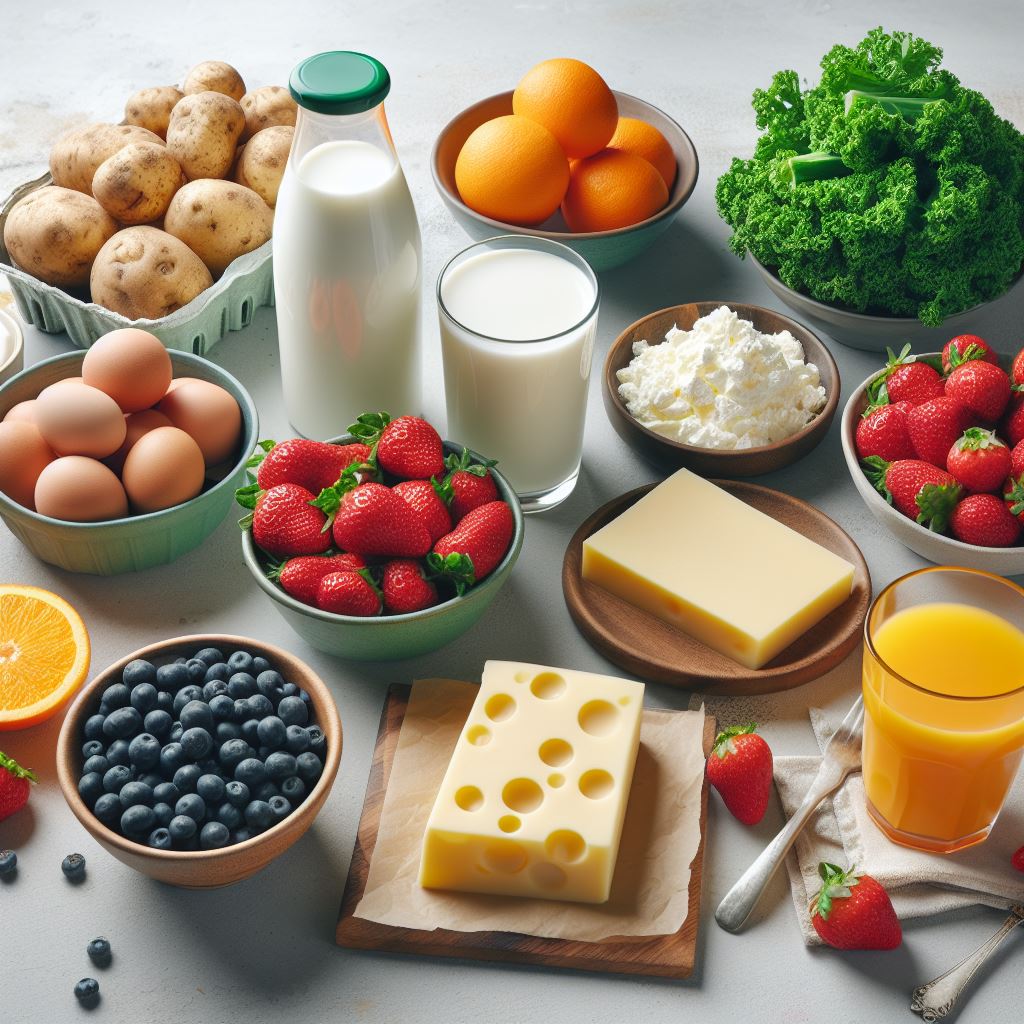
Of course it’s still a good idea for an expectant mom to make sure she’s getting enough calcium in her own diet. Some excellent sources of calcium are milk, cheese, and other dairy, as well as green leafy vegetables like kale. You can also take calcium supplements if you’re really concerned. Foods that are rich in vitamin C, like citrus, strawberries and potatoes, can also encourage the body to absorb even more calcium, to make sure your developing baby never has to go short. But once baby is born, it’s a different story.
When you’re breastfeeding, all of baby’s nutrition is still coming from mom, so her milk needs to have enough calcium to keep up with baby’s calcium requirement of 400mg per day. And this is where it turns a bit dark.
Because regardless of how much extra calcium she eats, or how much vitamin C she takes, mom’s body switches to doing things a bit differently. Instead of getting the calcium from her food, the breastmilk pulls its calcium direct from her BONES.
That’s right, when she’s breastfeeding a mom literally reabsorbs some of her skeleton to feed her baby. And when a newborn gets a milk feed, they’re actually chowing down on a kind of bone broth!

How does breastfeeding affect bones and teeth?
If you find it disturbing that your breastfeeding baby is literally eating away at your bones, then you’re not alone! And you might be left wondering what all that selfless calcium donation will end up doing to your body. But I promise, it’s not as bad as it sounds!
Many women complain of bone pain or joint pain after they’ve had children, and they might be worried that breastfeeding will cause bone density loss. There’s even an old wives’ tale that a growing baby will leach the calcium out of your teeth, leaving them chalky and prone to decay.
But, as I’m sure you’ll be relieved to learn, none of this is true! Calcium is taken from the bones, not the teeth, during breastfeeding, so your pearly whites are saved from a chalky fate! That’s not to say that your teeth won’t be affected when you become a mother, but it’s for an entirely different reason (a story for another time!).
And just as soon as baby is weaned off the breast, and mom is no longer repsonsible for supplying their calcium needs, then all of the calcium she eats is hers and hers alone again. It’ll be a matter of months before her skeleton is back to normal. Eating a healthy diet and supplementing calcium will help her increase bone density by about 2% per month.
So even though a mom’s body has evolved to make a serious sacrifice to nourish her newborn, it’s all temporary and really nothing to worry about. You can feed your baby, safe in the knowledge that their milky bone broth is just what they need, at no ultimate cost to you!
Read more:





 The Science Baby
Leave a reply to The Truth About Losing Weight While Breastfeeding – The Science Baby Cancel reply