
If you’ve ever had a newborn, you’ve probably heard it within days, sometimes minutes:
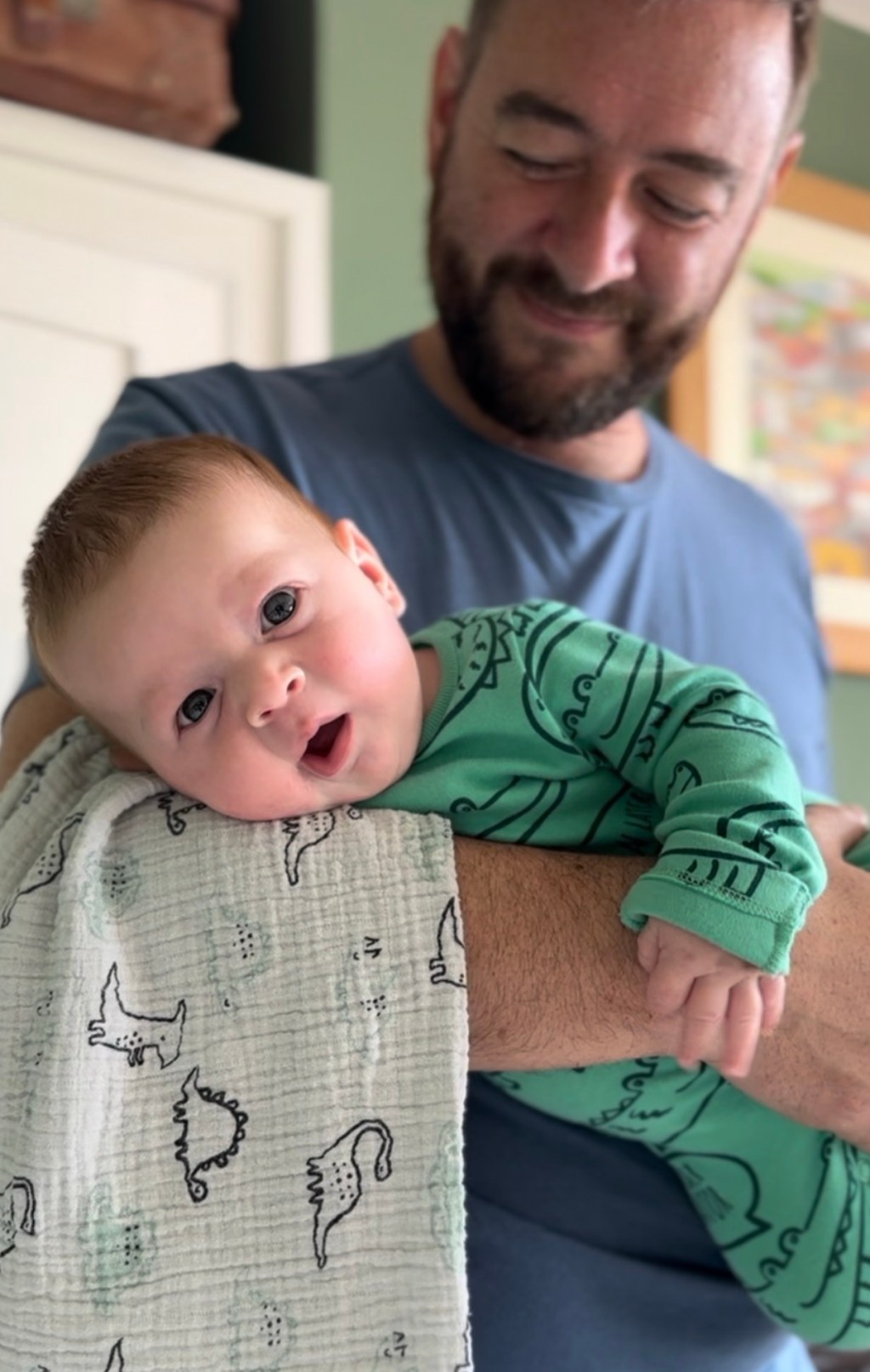
“Wow… they look just like their dad.”
For many mothers, this comment can land oddly. After months of pregnancy, birth, and round-the-clock feeding, it can feel as though all that effort has somehow produced a miniature version of someone else. Yet the claim is incredibly common.
Is there actually science behind it, or is it something we collectively imagine?
In this episode of The Science Baby Podcast, we unpack why so many people think babies resemble their fathers, what evolutionary biology has to say about it, and why the truth is far messier and more interesting.
What to Expect in This Episode
Leila and Kim share personal stories of strangers, friends, and relatives repeatedly insisting their newborns looked “just like Dad.” The pattern is so consistent that it begins to feel like a rule of nature.
But babies change rapidly. A child who looks like one parent at birth can grow into the other parent’s features within months. Smiles, facial expressions, and even head shape evolve as muscles strengthen and fat distribution changes.
This raises a key question: are we observing real genetic resemblance, or are we seeing what we expect to see?
Why Looking Like Dad Might Make Evolutionary Sense
From an evolutionary perspective, there is a neat theoretical argument for paternal resemblance.
A mother knows a baby is hers with near certainty. A father, historically speaking, does not have the same biological guarantee. In many animal species, males invest more resources in offspring they believe are genetically related to them. In extreme cases across the animal kingdom, males may even harm offspring they believe are not theirs.
In humans, we do not generally see such behaviour, but we do see evidence that paternal involvement improves outcomes for children, from emotional wellbeing to long-term health. So, in theory, a baby resembling its father could encourage paternal investment.
It is a tidy story. The trouble is, the data does not consistently support it.
Do Babies Actually Resemble Their Fathers More?
One influential study from the mid-1990s found that strangers were better at matching one-year-old babies to their fathers than to their mothers. This result made headlines and helped cement the idea that paternal resemblance is biologically real.
However, later studies struggled to replicate this finding. Research throughout the late 1990s and early 2000s produced mixed results:
- Some studies found no difference in resemblance.
- A few found stronger resemblance to mothers.
- Others found weak resemblance to both parents.
When multiple well-designed studies disagree, scientists start to suspect that the effect is either extremely small or largely psychological. The growing consensus among anthropologists is that there is no reliable biological rule that babies look more like their fathers.
The Psychology of Seeing What We Expect
So why does the perception persist?
Several factors are likely at play:
- Cultural Expectations – We may be socially conditioned to comment on paternal resemblance as a polite or inclusive gesture, especially toward fathers who can feel sidelined in early infancy.
- Confirmation Bias – Once the idea is planted, we notice comments that support it and forget those that do not.
- Maternal Generosity – Interestingly, some research suggests mothers themselves are particularly likely to say their baby looks like the father. This may be an unconscious or conscious way of encouraging paternal bonding and involvement.
- IVF and Donor Cases – Anecdotal reports show that even when a baby is not genetically related to the father, people still claim a resemblance. This strongly hints that perception, not genetics, is driving much of the effect.
Why Ambiguity Might Be the Real Evolutionary Advantage
Here is the twist: ambiguity itself may be beneficial.
If a baby strongly resembled neither parent, both might still feel a genetic connection. Evolution does not always favour clarity. Sometimes it favours flexibility. A blend of features, or a face that changes quickly in early life, may help maintain social bonds rather than undermine them.
Genetics is also extraordinarily complex. Facial structure is influenced by many genes interacting in non-linear ways. The result is often unpredictable, more like blending paints than copying and pasting features.
Can Dads “Change” How Much Their Baby Looks Like Them?
One particularly fascinating line of research suggests that perception of resemblance is influenced by bonding.
Studies have found that fathers who spend more time in close physical interaction with their babies, for example through baby massage classes or extended caregiving, are more likely to report that the child resembles them strongly. External observers do not necessarily agree. The shift is in the father’s perception.
In other words, investment may increase perceived similarity, which in turn reinforces further investment. It becomes a self-strengthening loop powered by psychology rather than genetics.
The Future of Your Baby’s Face
Newborn faces are famously fluid. Puffiness reduces, skull shape adjusts, muscles strengthen, and expressions emerge. A baby who looks like a “tiny grandfather” in week one may look entirely different by month six.
Over time, most children grow into a recognisable blend of both parents, with certain expressions or angles evoking one more than the other. The resemblance story is not static. It unfolds.
So, Do Babies Look Like Their Dads?
Sometimes yes. Sometimes no. Often, it depends on who is looking and why.
The strongest evidence suggests that newborn resemblance is less a fixed biological rule and more a mix of genetics, social expectation, and human psychology. The comforting or frustrating comments we hear in those early weeks may reveal more about our cultural scripts and bonding instincts than about our children’s DNA.
And occasionally, babies just look like tiny elderly men. That, at least, seems universal.
Listen to The Episode
👉 You can watch and listen to the latest episode right here:
Or find The Science Baby Podcast on your favourite podcast app.
Join the Science Baby Community
We’d love to hear what you think about this episode, and the podcast in general!
Leave us a review, share this episode with a fellow parent, or drop us a message with the topics you’d love us to cover.
And make sure to follow us on Instagram, Facebook, TikTok or YouTube to make sure you never miss an update.

 The Science Baby
Leave a comment