
If there’s one thing newborn babies are good at, it’s crying. Loud, insistent, impossible-to-ignore crying. But if you’ve ever held a newborn, you might have noticed something strange: those first wails come with sound, but not with visible tears.
When Science Baby cried real tears for the first time, at about a month old, it was a moment I’ll never forget. Up until then, his cries had been noisy and demanding, but when those first tears rolled down his cheeks, it hit me differently. Suddenly his distress looked raw and human in a way that made my heart lurch. And yes, it made me cry too.
So why is it that babies don’t cry real tears right away?
The Newborn Tear Timeline
At birth, babies already have tear glands (called lacrimal glands) that produce a small amount of liquid. This is enough to keep the eyes moist and healthy, but not enough to overflow.

Here’s what typically happens:
- From birth – Tear glands make minimal fluid for lubrication.
- Around 2 weeks old – Production begins to ramp up, though often still invisible.
- Between 1 and 3 months – Most babies produce enough tears that they spill over during a cry. For parents, this is the first time cries come with visible waterworks.
Research backs this up: tear volume increases significantly in the weeks after birth, which explains why crying looks so different in the early months.
Glands vs. Ducts: A Common Mix-Up
This is a good time to clear up a common misconceoption. Many people assume tears come from the tear ducts. In fact, it’s the opposite.
Lacrimal glands, at the outer top corner of the eye, just under the browbone) are the tear factories. They produce tears that wash across the eye’s surface.
Whereas Tear ducts, at the inner corner of the eye, are the drains. They funnel excess tears into the nasal cavity, which incidentally is why your nose runs when you cry.
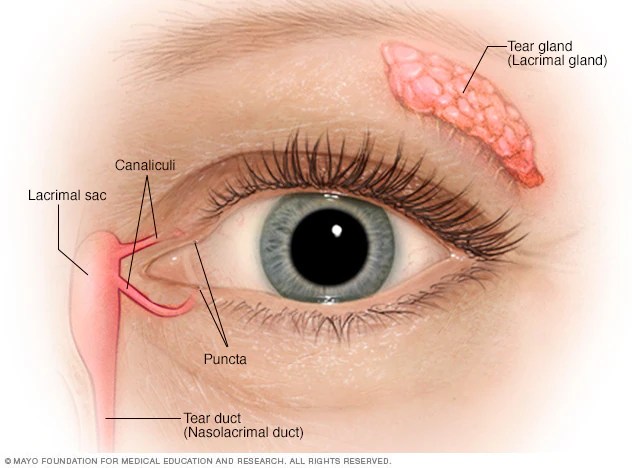
When babies’ lacrimal glands eventually start producing tears in earnest, the ducts can’t drain them all away. That’s when you finally see tears trickling down their cheeks.
Why Do We Cry Tears at All?
Here’s the fascinating part. Humans are the only animals that shed tears for emotional reasons. Other animals make tears for eye health, but not for sadness, frustration, or for joy.
So what purpose do emotional tears serve? Scientists have a couple of theories:
First, they could be for stress release. Emotional tears contain hormones and proteins linked with stress, which aren’t found in normal eye moisture. Some researchers think shedding these chemical-rich tears might actually help to rebalance the body, though it’s debated how significant the effect really is.
Second, it could be a form of communication. Tears are an unmistakable signal that something is wrong. Unlike tone of voice or facial expression, liquid streaming down your face is very hard to misinterpret. Studies show that seeing someone cry activates the same brain regions as feeling upset yourself, making tears a powerful trigger for empathy.
For babies, this timing is especially clever. Just as parents’ postnatal hormones are shifting, emotional tears arrive, intensifying the instinct to respond to every cry. Another example of how our tiny humans seem to have us wrapped around their fingers (or, in this case, tear ducts).

When to Expect Tears, and When to Ask for Help
Most babies will show visible tears between 2 weeks and 3 months old. If your baby is still crying without tears by 3 months, or if you notice constant tearing, redness, or discharge, it’s worth checking in with your pediatrician.
A common issue is a blocked tear duct (dacryostenosis), which affects up to 20% of newborns. Usually it clears up naturally within the first year, sometimes with gentle massage, but occasionally it needs a little medical help. So it never hurts to keep an eye out… if you excuse the pun!
The Takeaway
- Newborns cry, but not with visible tears right away.
- Tear glands are immature at birth, and tear volume ramps up between 2 weeks and 3 months.
- Tears are made by glands, not ducts. Tear ducts are simply the drains.
- Emotional tears may help relieve stress, but more importantly, they’re an empathy signal, especially powerful between parents and babies.
So when Science Baby cried real tears for the first time, it wasn’t just biology catching up, it was evolution in action. His body had unlocked a new way to communicate his needs: one perfectly designed to get a quick response. And judging by how fast I picked him up, it worked.
Read More
- When Do Babies Start Crying Tears? – Healthline
- Why Newborns Cry Without Tears – Live Science
- Infant Tear Production: Clinical Study on Lacrimal Gland Development – PubMed
- Blocked Tear Duct (Dacryostenosis) in Babies – Boston Children’s Hospital
- The Science of Tears: Why We Cry – Verywell Family





 The Science Baby
Leave a comment