
Newborn babies are often perceived to look more like their fathers than their mothers. While children inherit genes equally from both parents, evolutionary biology and psychology offer a compelling explanation for why paternal resemblance is so commonly noticed, and talked about, in early infancy.
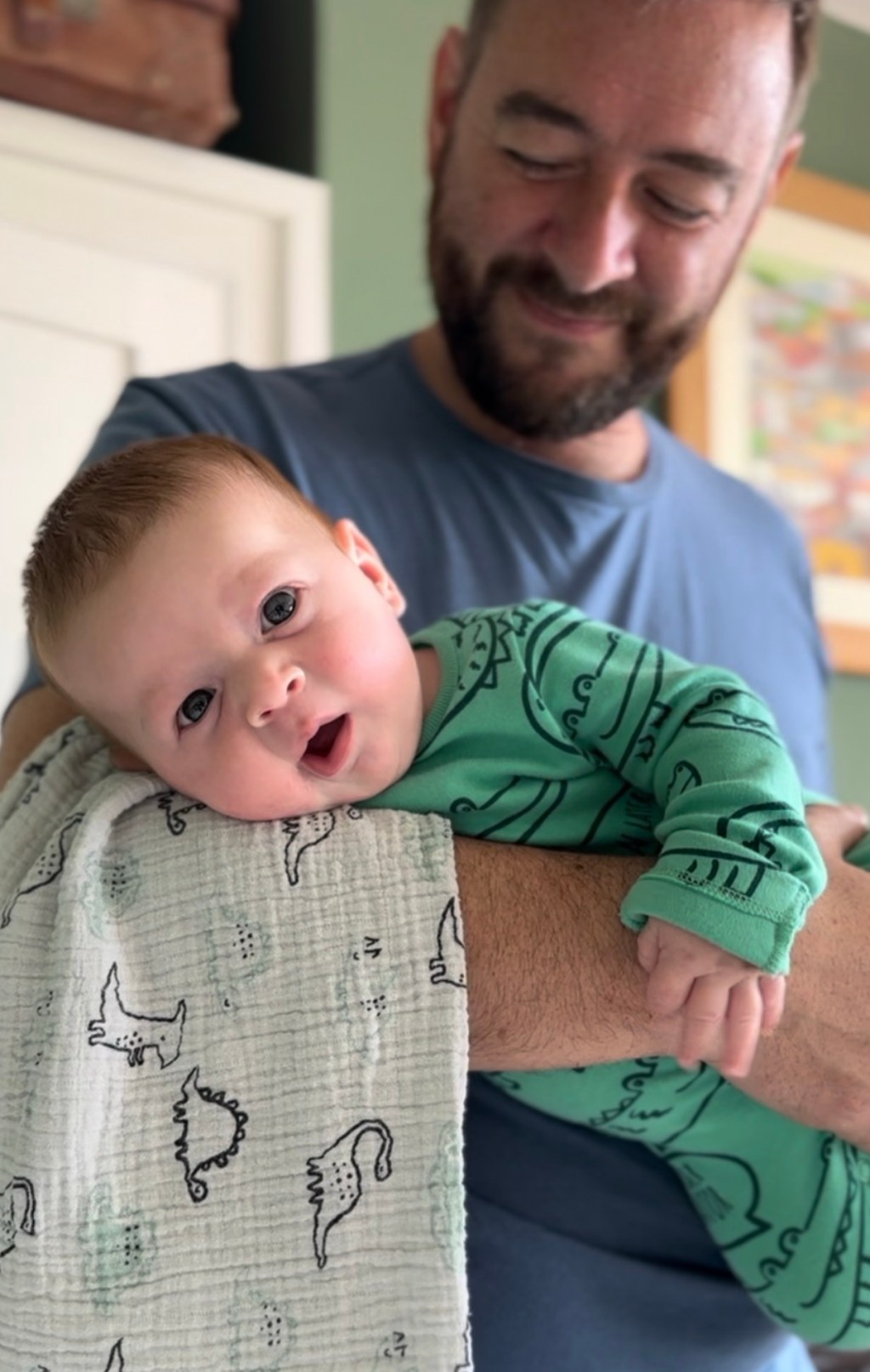
When science baby was born, pretty much the only thing we heard for the first year or so was how much he looked like his dad! Which, as a mother (who had gone through the gruelling, invasive process of IVF, carried and grown this child for nine months, and gone through four days of induction and birth, not to mention feeding him from my own body and having my mind and body completely transformed by the process), was the last thing I wanted to hear.
The worst part was, they were right! This tiny scrap of humanity was a carbon copy of his dad. I could see it, and so could everyone else. It was lovely and horrible in equal measure! I clung onto those rare interactions where a kind friend or unsuspecting stranger said they saw my resemblance in him as well!
When I shared my frustration with those closest to me, it turned out that my experience was not unique. Lots of long-suffering mothers were caring for kids that (as far as everyone told them, at least) looked more like their dads. Which got me thinking, what’s the science behind it?
Do babies really look like their fathers when they are born?
Genetically, a baby is a mixture of their two parents. But the way genes are inherited and the way they’re expressed can vary on an individual basis. So things like eye colour and hair colour can be all mom, or all dad, or come as a surprise. There are lots of reasons why a baby might come out looking more like their mom or their dad. And that can change as they grow older, too.
But there’s one good reason why looking like dad might be a good thing, and that’s paternal confidence!
The vast majority of mothers have biological confidence in their children. After all, they literally grew and pushed (or had sliced) out this human being, saw them attached to their insides, and, barring any serious hospital mixups or misdemeanours, have an unbroken chain of custody from that very first cry.
Fathers, on the other hand, are never so sure. They were involved in the process just once, many months earlier, and have only the mother’s memory or loyalty to go on. Even IVF dads have to put their trust in the labelling of pots!

So, evolutionary psychologists have suggested that babies who physically resemble their dads are more likely to be accepted by those fathers. As a result, they’re more likely to receive care, attention, and resources, boosting their survival chances.
Dads go through neurological and hormonal changes (similar to what moms go through during Matrescence), with lower testosterone and higher oxytocin that supports nurturing behavior and bonding. It makes sense that they will only want to go through all of this for a child that is demonstrably theirs.
This has been backed up by data too. A study in 2014 measured facial resemblance between French children and their fathers, and rated how close those fathers felt to their children. The results showed that the emotional closeness and resemblance were correlated: the more a kid looked like their dad, the closer those dads felt to their kids.
I’m sure we’d all like to think that we’ve moved beyond these kind of primal, animal instincts, but in reality we’re not so different from our animal cousins after all.
Conflicting Evidence
So, if there’s a real evolutionary advantage to babies looking like their dads, then is it true that babies always look like their dads?
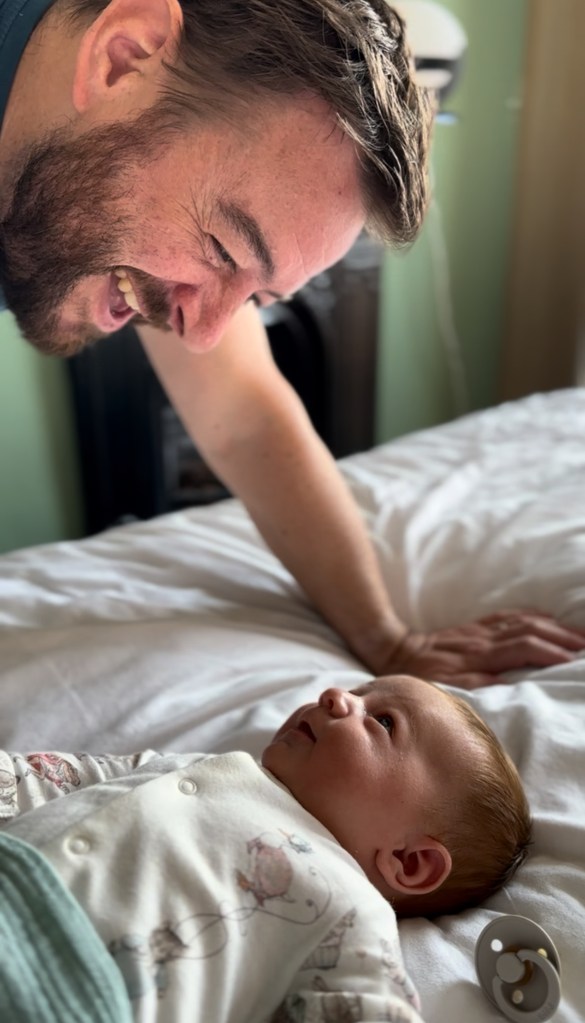
In 1995, researchers used an experiment where neutral observers had to match photos of 1 year olds to those of their parents. Significantly, the results showed that these people were better at matching the kid to the father than they were to the mother, strongly suggesting that there is a greater resemblance between dads and their kids than between moms and their offspring. This seemed to confirm it – on average, babies look more like their dads.
However, this wasn’t the only study that’s been done, and not all of the results say the same thing. Several studies have expanded on that same photo-matching research, using a wider range of pictures, as well as a wider age range of kids. And in all of those, people were able to match kids to their mothers and fathers with about equal success rates. That suggests that, on average, children resemble both of their parents equally. There was no consistent bias towards dad.
Interestingly, in evolutionary biology, researchers have found that when the paternity of a child is not certain, or where there’s a high risk of conflict arising from paternity clashes, then ambiguous resemblance might actually be a good thing. In these situations, if a baby doesn’t strongly resemble the dad, then that father may be less likely to harm or reject them. One study in 2021 revealed that promiscuous fathers, who had many sexual relationships and several children raised by different families, ended up with sons who looked less like them.
The eye of the beholder
The thing that all of these studies have in common is that they used strangers to match the babies to their parents. And while these neutral, objective observers might be able to see no particular resemblance, it’s a very different story when you ask mom. Regardless of what strangers might think, moms frequently insist that their little ones look like their fathers (despite the self-sacrifice of motherhood!)

Psychologists believe this behaviour also has its roots in evolution. If a mother can consciously or unconsciously persuade a father that the baby is his, then she’s more likely to secure his care and protection. So it follows that she’s conditioned to see his features in the baby, to then pass on her certainty and ensure her baby’s survival.
And so, while observers tend to say babies look more like mom, mothers themselves unconsciously emphasise resemblance to dad, boosting paternal certainty, even while, in her conscious mind, it stings to admit it!
Nurturing resemblance
The studies seem to show that paternal resemblance is in the eye of the beholder. But there’s an intriguing twist to this tale – you can change how that eye beholds.
The more involved a dad is with their kid, the more similar they will appear to be – at least in the eyes of the father. In one study from 2010, dads were given infant massage lessons with their babies, and afterwards they rated their resemblance to those kids higher than they had before. Not only that, but the sessions helped to reduce their stress: win win! It’s important to note that a daddy-daughter massage won’t actually change how the kid will look, or their underlying genetics, but it does seem to shift how the dads see their offspring. And that, presumably, will subtly change how they behave towards them.

In other words, it goes both ways. Bonding boosts perceived similarity, which encourages more bonding.
So, Do Babies Look Like Their Dads?
There’s conflicting evidence out there, but the emerging picture is that, if you think your kid looks like their dad, then it’s all in your head!
But that isn’t necessarily a bad thing – because perception can be a powerful thing, and what you think influences how you behave. Mothers are hard-wired to care for the child they grew, but resemblance helps to illict that nurturing behaviour from fathers too.
Ultimately, that classic “He looks just like you!” often reflects a blend of genetic chance, mom’s persuasion, dad’s love, and deep-seated evolutionary psychology.



 The Science Baby
Leave a comment