
As soon as you announce a new pregnancy to the world, it seems that open season begins for nearly everyone to ask personal questions. Questions like:
- How far along are you?
- How are you sleeping?
- How’s the morning sickness?
- Do you know if it’s a boy or a girl?
As if, under any normal circumstances it would be appropriate for an acquaintance or even stranger to ask you how much you were throwing up in the average week.
This seems to have become the de facto small talk when conversing with a pregnant person, and for the most part we go along with it. In some ways it’s a form of social comparison, allowing people to measure their own or their loved ones’ pregnancies against yours.
But this shared social experience means that, after the questions, come the confident proclamations, based on the most tenuous information.
- You bump is sitting low, you must be having a boy
- Ooh you’re wearing high heels, baby will come out cross-eyed
- Baby girls steal your beauty, you’ve got a girl in there (rude!)
- Lots of heartburn? You’re going to have a hairy baby!
With the exception of that last one, all of these are basically just folk tales, or old wives tales, that build upon generations of oral hearsay, bolstered by a healthy dose of confirmation bias.
But there is truth in the fact that heartburn is linked to hairy babies, thanks to hormones that affect them both.
And there’s one other folk tale that might have some truth in it as well – that lots of morning sickness means you’re having a girl.
All Day Sickness
Morning sickness is considered to be such a ubiquitous part of early pregnancy, that it’s one of the first thing anyone will ask about when they learn that you’re in the family way. Indeed, to many women who have conceived unexpectedly, it may be one of the first signs that they are in fact pregnant.
And yet, anyone who has experienced it will tell you that morning sickness is a pretty inaccurate term. The nausea and vomiting that peaks during the first few months of a pregnancy has no regard for the time of day. It doesn’t keep itself to just the mornings, but can happen at any time of the day or night. Women might be hit with a flush of nausea when they wake up, but there’s nothing stopping the feeling continuing through the rest of the day.
Up to 80% of moms will experience some nausea between weeks 6 and 16 of a pregnancy, and some researchers have suggested that it’s evolved to protect mom from potentially dangerous foods during the most vulnerable part of their pregnancy. Protection notwithstanding, the sickness can really put a dampener on the first trimester.
But some women, up to 3%, will suffer much worse with pregnancy nausea and sickness, suffering from a condition called hyperemesis gravidarum. In the first trimester, they may be sick several times a day, being unable to keep food down. And the sickness may continue throughout their pregnancy, resulting in dangerous weight loss at a time that they should be laying in reserves for their newborn, leading expectant moms to need medical treatment and even hospitalisation.
Sickness Hormones
Scientists still don’t know exactly what causes pregnancy nausea and sickness. For something that affects around half of all women in the world, that’s pretty shocking, but sadly not surprising, given that women’s issues and the subject of matrescence have been, and continue to be, neglected in a male-dominated society.
But one of the leading theories is that the sickness is triggered by a hormone called human chorionic gonadotropin, which is mercifully shortened to hCG.

hCG is a hormone that’s produced first by the embryo, and then by the developing placenta, which helps the lining of the uterus to grow thicker to provide a cosy home for the fetus. This chemical messenger is actually what bloodwork and pee-on-a-stick pregnancy tests are looking for, because it’s the most reliable indicator of a successful early pregnancy.
It’s not clear why hCG should cause nausea and pregnancy sickness, but the correlation is a strong one when you consider when the two are happening. Pregnancy sickness peaks during the first trimester, at the same time that hCG is flooding the body. Some have suggested that women’s bodies are unused to having this chemical circulating around, and so the natural response to the foreign molecule is sickness, to try and purge it away.
Without a causal factor, the jury is still out on hCG though, as some studies haven’t found strong links between it and pregnancy sickness. Other hormones and early pregnancy chemicals, like oestrogen, progesterone, and a molecule called GDF15, produced by the placenta, have all been implicated on the same basis – that their concentrations spike at the same time as the sickness is happening. But it’s clear that there’s still plenty of work that needs to be done to understand it.
Truth in the Tales?
Despite a general lack of understanding around pregnancy nausea and sickness, another correlation has been noticed – that women who get severe sickness in pregnancy are more likely to give birth to a girl.
The idea stems from two separate trends:
- Women who get hyperemesis gravidarum typically have higher levels of hCG, and
- Higher levels of hCG are present when the mother is carrying a female baby
That second point has plenty of evidence behind it – one study in 2015 found that mothers carrying female babies had 11% more hCG in their blood during the first trimester, and 8% more in the second trimester. It’s a significant difference, sure, but is it enough to make a difference? On that, it’s not completely clear.
In 1987, a Swedish study of more than 3000 pregnancies in which severe sickness was diagnosed found a higher chance of having a girl. Female babies made up 53% of all births, compared to the national average of 49%. However with hyperemesis gravidarum making up less than 1% of all the cases in the hospital registry, and the relatively small increase in female babies, this is hardly the most convincing evidence.
Another study, in 2004, of women who ended up in hospital with their severe sickness in their first trimester found that the chances of them having a female baby were up to 50% higher. Again, this is a significant trend, but it’s not the strongest of links.
And while these studies have identified the small but significant correlations, others have found now associations at all.

So the jury’s still out. It might be that the link is stronger among certain ethnic groups, or there’s some other characteristic of the mother that means the relationship is more obvious. But there’s still much more research to be done before we can identify such a link with confidence, or explain how it comes about.
What about you?
As for us, well, I was lucky. I didn’t get much sickness or nausea at all (although tragically she developed an aversion to two go her favourite foods – coffee and kebab!). Then, as I’m sure you know, I came out with my meat and two veg, so I guess we fit the pattern.
And in Science Baby’s Big Parenting Survey 2025, which, by the way, you can still participate in, by following this link, we asked about the sex of your baby and the severity of your sickness, and (at the time of writing, out of 3200 responses) this is what we found:
- 57% of all babies were male, and 43% were female
- 71% of mothers experienced some morning sickness, and 12% reported having hyperemesis gravidarum
- Out of those who had hyperemesis gravidarum, 46% had girls, compared to the overall average of 43%. So, like the published studies, that’s a slight increase on the overall average.
- But more significantly, the mothers who reported having no morning sickness at all were much more likely to be carrying boys. Those with no sickness had boys nearly 63% of the time, compared to the overall average of 57%
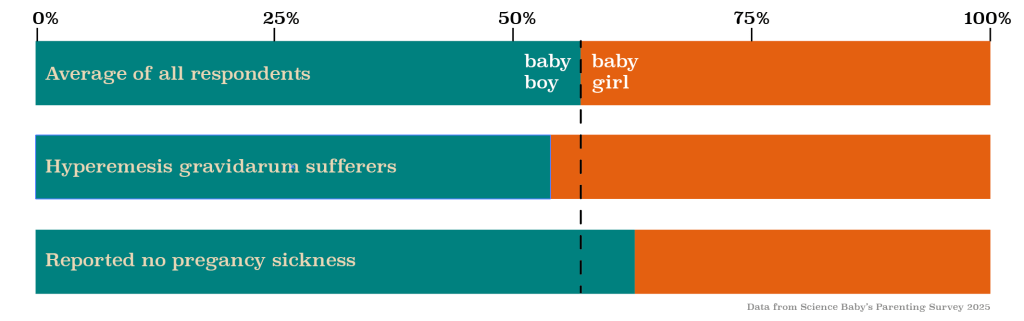
So, our citizen science data does seem to support the folk tale and the studies that suggest that more sickness means you’re having a girl. But it’s worth bearing in mind that none of these trends are particularly strong. We’re talking about increases in probability of just a few percent.
Having bad pregnancy sickness doesn’t necessarily mean you’re having a girl, and having no sickness at all doesn’t necessarily mean you’re having a boy. When it comes down to it, your chances of either are still roughly 50:50, regardless of how often morning sickness strikes.





 The Science Baby
Leave a comment