
Imagine one million people, about the same number of people who live in Edmonton in Canada, shaking hands with another million people, like the population of Ottawa. Then, the next second, they shake hands with another million people, like the population of Panama City. A second later, they greet a different million, and the next second, yep, another million. It seems like an impossible rate to meet people, and yet this is the speed at which nerve cells are connecting with other nerve cells inside an infant’s brain.
That’s right, inside their growing brain, your little one is making one million connections per second, every single second, for the first few years of their life.
And unlike the handshake analogy I used above, they’re not fleeting touches before moving into the next group, these are connections that, once forged, stay forged for many many years, if not for the whole of their lives.
How is this possible? And why are babies’ and toddlers’ brains doing this in the first place?
How to build a brain
As early as three weeks after conception, a developing foetus starts to grow neurons.
Neurons, or nerve cells, are specialist cells inside animal bodies that are capable of transmitting a tiny electrical signal from one place to another, to coordinate thoughts and movements. Neurons in the brain are just a tiny fraction of a millimeter across, but they’re structured a bit like a tree, with lots of branches that extend out from the centre. Some neurons elsewhere in the body have one extra long branch, called an axon, that can stretch as far as a metre or more.
By the time they are born, a baby will have billions of neurons in their brains and bodies.
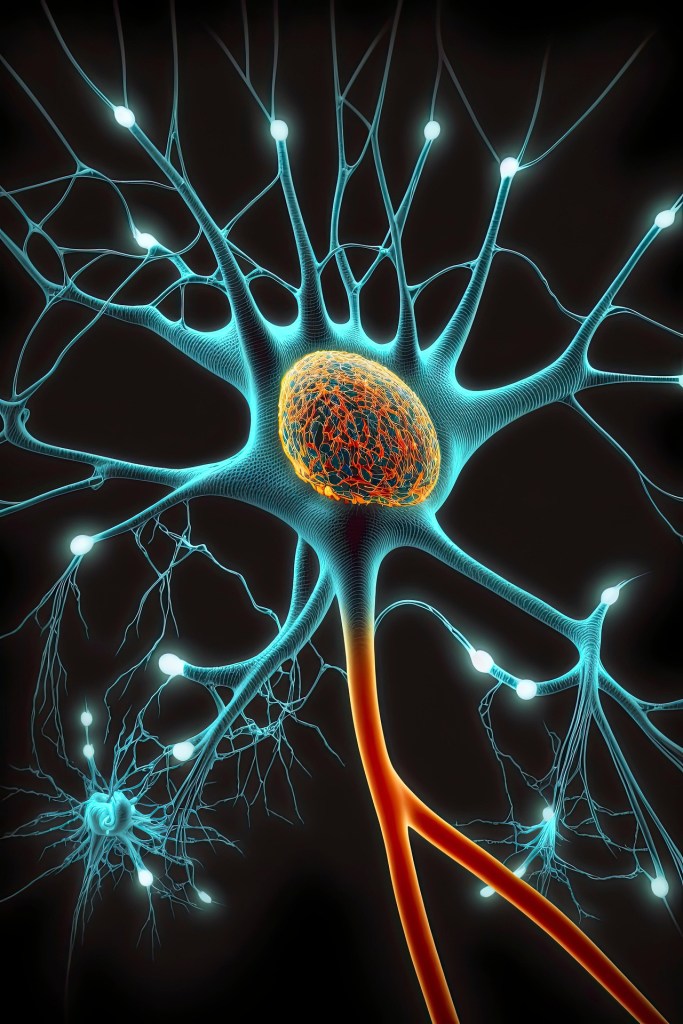
All neurons pass information along in the form of tiny electrical signals, called impulses, that are generated by tiny differences in charge between the inside and outside of their cells. Once triggered, an impulse can travel through the nerve cell at up to 350 miles per hour. But these electrical impulses only happen within a neuron, and there’s not much point in having information if you can’t do anything with it. To actually do their job, neurons need to be connected to others – to receive the information from one part of the body and pass it onto another part, with or without some processing along the way.
And while a newborn has all those neurons in their little brains, for the most part they’re just hanging out on their own, not connected to anything. Sure, they’ve got the important ones that help them breathe, blink occasionally, cry and poop, but the majority of their neurological wiring is surprisingly incomplete.
So little ones will spend the first few years of their lives frantically wiring together their brains. And because the human brain is such an incredibly complex organ, they’ve got their work cut out. Billions of neurons, each with many different branches, need to reach out connect with others – effectively shake hands – at the staggering rate of one million connections per second.
Keeping up this pace for 86,400 seconds a day, 365 days a year, by the time they’re three, they’ll have on the order of 100 trillion connections.
Learning to be a human
At the end of your child’s toddler years, their brains will have been transformed from a kind of soup of isolated nerve cells, to a densely interconnected network of interlinking neurons. How does that change things?
Well, all of this linking and wiring essentially builds up the architecture of the brain, which becomes the basic foundation for an individual’s physical, mental, and emotional health for the rest of their lives.
So yeah, it’s kind of a big deal!
But as we grow up, from not being able to really do or think anything as a newborn, to being a fully functional human being, this special period of brain development means that we’re able to absorb a staggering amount of information during our early years.
You’ve probably seen it in your own little one – they’re assimilating information, figuring stuff out, and acquiring new skills at an incredible rate.

They’re discovering their own body parts, learning to roll over, crawl, walk, run and jump.
They’re figuring out how to use their voices, identify mom and dad, and learning how to talk using the words they’ve heard.
And they’re learning that they are their own unique person, with thoughts and feelings that are separate from others. Eventually, they’ll be able to recognise and regulate their emotions, too.
At times, it can be as if a literal light bulb has gone on inside their heads. One minute they’re sitting on their bums staring blankly into space, and the next they’re running around the kitchen asking Alexa to play wheels on the bus (yes that really happened, and we caught it on video!)
Absolutely all of this physical, mental, social and emotional foundation is powered by the interconnected neuronal fireworks inside our brains, and the majority of it is set up in those first few years of a child’s life.
Nature and Nurture
Now, we’re all individuals, and we assimilate information in different ways, meeting milestones in a general pattern but on our own unique schedule.
Although we inherit the basic blueprint for brain architecture from our parents, it’s the things that we experience during this critical time that really determine which connections end up getting made.
The more things that your child experiences when they’re young, the more varied connections they will end up making in their developing brains.
It doesn’t have to be anything big or flashy. You don’t need to be taking your 1 year old to Disney, or getting them piano lessons as soon as they can sit on a stool. But simple things can make a big difference, like taking them out to the park, trying new sensory activities, and introducing them to people of all different ages, races and abilities. All of that is going to be much more valuable to their development than sitting in front of a TV or tablet screen for several hours a day (not that screens themselves are bad, but everything in moderation!)

Not only that, but the interactions you have with your child at this stage are critical to their mental and emotional development. Science has shown that positive, loving interactions are directly correlated with healthy brain growth, while episodes of trauma during the early years can be linked to developmental delays.
Of course, we’re all guilty of snapping or reacting to our child in a less than ideal way now and again, but that doesn’t necessarily mean you’re going to harm their brain growth. As long as the overall environment is more positive than negative, then they’re going to be on the right track.
Build up to prune back
During the first few years of their lives, new experiences help babies and toddlers to connect up their brains to help understand the world around them and learn new skills. But a lot of that learning is pretty indiscriminate. They’re assimilating a ton of information without learning what’s important, what’s worth remembering, and how they really feel about it.
When you think of it, that kind of explains why they’re so unpredictable, and let’s face it, often unreasonable!
The sorting, organising, prioritising and memorising of information comes after the information has been assimilated in the first place. So, after the trillions of neural connections have been formed, a new human will spend the rest of their lives either reinforcing their neural pathways, or pruning them back.
Learning, through repeated exposure, will help to reinforce certain connections, building a kind of mental highway that will make it easier and easier to access the information later on.
Meanwhile, information that is less relevant in adulthood, and which might not be repeated as they get older, can disappear into the background as the neural connections are physically pruned back.
So, some of those trillions of childhood connections won’t stick around, but many of them will, and nerve connections can’t be reinforced or pruned if they haven’t been made in the first place.
It’s been shown that the plasticity of the brain – its ability to physically change its structure to adapt to new environments and needs – decreases as we get older, and it is never more adaptable than in these critical early developmental years.

So even though they might not remember everything from this time, the things your little one experiences in their first few years actively shapes the people they’re going to become.
And at a million connections a second, every second really does count. No pressure!



 The Science Baby
Leave a comment